This guide walks through everything you need to know about MS hollow section pipe sizing, from what the numbers on a chart actually mean to how weight, thickness, and grade all connect. Whether you're a contractor, fabricator, or architect specifying material for the first time, this should make the whole process a lot less confusing.
What Is an MS Hollow Section Pipe?
An MS hollow section pipe is a mild steel structural tube with an empty core, manufactured in square, rectangular, or circular cross sections. Compared to a solid steel bar of the same weight, a hollow section gives you significantly more strength, which is exactly why it's become the default choice for columns, trusses, frames, railings, and other load bearing members across construction and engineering.
You'll come across a few different names for the same product depending on who you're talking to. Some people call it mild steel hollow section, others say MS hollow pipe, and on technical drawings it usually shows up as structural hollow section, or simply SHS, RHS, or CHS depending on the shape. All of these refer to the same underlying category of product, just described slightly differently by different people in the supply chain.
An MS hollow section pipe is typically rolled from HR (hot rolled) coil, formed into shape, and welded along its length using ERW (Electric Resistance Welding). The steel starts as flat coil, gets levelled and shaped through a series of rollers, and is then welded, sized, and cut to length, usually 6 to 7 metres for structural applications in India.
MS Hollow Section Pipe Shapes: Square, Rectangular, and Circular
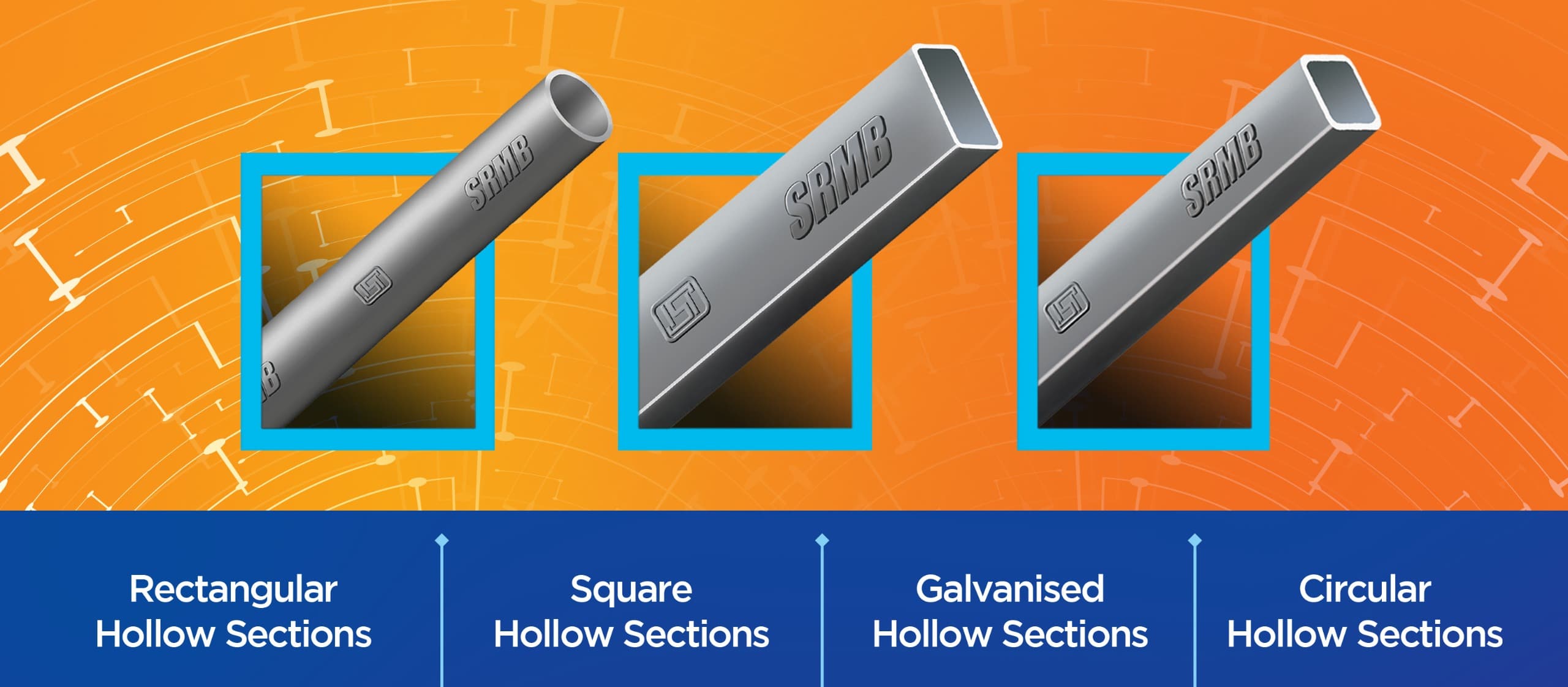
Every MS hollow section pipe falls into one of three shape categories, and each one suits slightly different applications.
MS square hollow section, also called SHS, has four equal sides, which spreads structural load evenly in every direction. It's a common choice for columns, general fabrication work, and frames where symmetrical strength matters more than directional strength.
MS rectangular hollow section, or RHS, has two pairs of unequal sides. This gives it more strength along one axis than the other, which makes it a natural fit for beams, trusses, and roof support systems where load travels predominantly in one direction.
MS circular hollow section, or CHS, is the round variant, often just called MS round pipe or MS pipe in casual conversation. Circular sections handle torsional loads particularly well, so they're widely used in railings, staircases, pipe racks, and mechanical applications where twisting forces come into play.
Each of these shapes is manufactured to its own Indian Standard. Square and rectangular MS hollow section products generally follow IS 4923, while circular hollow sections follow IS 3601, with IS 1161 also commonly referenced for structural steel tubes.
MS Hollow Section Sizes and Dimensions
MS hollow section sizes are usually listed as size range and thickness range together, since both numbers matter when you're specifying material.
For square hollow sections, sizes typically run from around 20mm x 20mm on the smaller end up to roughly 91.5mm x 91.5mm for heavier structural work, with wall thickness options ranging from about 1.0mm up to 4.8mm depending on the manufacturer's range. Rectangular hollow sections follow a similar pattern, starting around 40mm x 20mm and going up to about 96mm x 48mm, again across a range of thickness options.
Circular hollow sections are described a bit differently, using Nominal Bore (NB) rather than a width and depth. A typical MS hollow section pipe range for CHS starts around 15mm NB and extends up to 80mm NB, with outside diameters running from roughly 21.3mm to 88.9mm, and thickness generally available from 1.8mm through to 5.4mm.
Here's a simplified look at how MS hollow section dimensions typically map across the three shapes:
| Section Type | Size Range | Thickness Range |
|---|---|---|
| Square (SHS) | 20x20mm to 91.5x91.5mm | 1.0mm to 4.8mm |
| Rectangular (RHS) | 40x20mm to 96x48mm | 1.0mm to 4.5mm |
| Circular (CHS) | 15mm NB to 80mm NB | 1.8mm to 5.4mm |
Grades commonly used across these ranges are YST 210 and YST 240, with higher grades also manufactured for projects that call for greater yield strength.
Understanding MS Hollow Section Weight
MS hollow section weight is one of the most practical numbers you'll deal with day to day, since it drives transport cost, load calculations, and how quickly a supplier can quote a firm price.
Weight per metre depends on both the size and the thickness of the section, not the size alone. A 40mm x 40mm square hollow section at 2.6mm thickness weighs noticeably less than the same 40x40 section at 4.0mm thickness, even though the outer dimensions are identical. That's because the extra steel in a thicker wall adds directly to weight, without changing the section's outer footprint.
This is why every proper MS hollow section pipe chart lists weight alongside size and thickness, usually in kg/m, and sometimes as metres per metric tonne (Mtrs/M.T) for bulk ordering purposes. If you're pricing out a large order, cross checking the weight column against your engineer's structural calculations is a good habit, since it confirms you're getting the load bearing capacity the design actually needs, not just a section that looks right on paper.
Why Manufacturing Quality Matters for MS Hollow Section Pipe
Dimensional accuracy on an MS hollow section pipe isn't just a nice to have, it directly affects how the section performs once it's welded into a structure.
Because engineers design around specific values like moment of inertia, section modulus, and radius of gyration for each size and thickness combination, even small deviations in actual dimensions can throw off load calculations. A section that's slightly out of tolerance on squareness, corner radius, or wall thickness might still look fine to the eye, but it can behave differently under real load than the chart promised.
Good manufacturers address this through a controlled process. Raw HR coil is checked for chemistry, the strip is levelled and shaped through precision rolling, and the weld itself is inspected, since a weak or inconsistent longitudinal weld is one of the more common weak points in a lower quality MS hollow section pipe. Batch testing using equipment like digital Universal Testing Machines and spectrometers is what actually confirms mechanical properties like yield strength and tensile strength match the stated grade, rather than just assuming they do.
Surface finish and straightness matter too. A properly straightened, uniformly finished MS hollow section pipe is easier to cut, weld, and fabricate on site, which saves time and reduces wastage during installation, something that adds up quickly on larger projects.
Common Applications of MS Hollow Section Pipe
MS hollow section pipe shows up across a wide range of industries, largely because it offers a strong, lightweight, and design flexible alternative to solid steel bar or open sections like angles and channels.
- Architectural: glass curtain wall frames, partition frames, space frames, guard rails, and staircases.
- Industrial: sheds, material storage racks, pipe racks, columns, trusses, and roof support systems.
- General engineering: amusement park structures, greenhouses, exhibition stalls, furniture, and solar power plant structures.
- Infrastructure: bus stands, railway platforms, foot over bridges, stadiums, and airport terminals.
Anywhere that needs a strong, lightweight structural frame without excessive material cost, hollow sections are a natural fit.
Choosing a Reliable MS Hollow Section Manufacturer in India
When you're comparing suppliers, it helps to look past price alone and check a few fundamentals. Confirm which IS standard the manufacturer certifies against (IS 1161, IS 3601, and IS 4923 cover most structural hollow section needs in India), ask whether raw material chemistry is controlled to IS 10748, and check if batch testing is actually done on equipment like UTM and spectrometers rather than just claimed on paper.
It's also worth asking whether the manufacturer runs an integrated process, from raw billet through to the finished, welded section, since that level of control tends to produce far more consistent MS hollow section pipe dimensions than a fragmented supply chain where coil, forming, and welding happen at different facilities.
SRMB RealFabrica manufactures ISO certified MS hollow sections including square, rectangular, and circular structural pipes, built to IS 1161, IS 4923, and IS 3601 standards. As part of the SRMB group, backed by more than seven decades of steel manufacturing experience and classified as a Primary Steel Producer by India's Ministry of Steel, every batch is checked using digital Universal Testing Machines and spectrometers under a quality framework the company calls PAWS Technology, covering physical uniformity, accurate sizing, weld quality, and surface strength. You can browse the full range of sizes, dimensions, and specification charts across our product range.