This guide walks through what nominal diameter actually means, how it connects to wall thickness, and how to read a steel pipe size chart without second guessing yourself. Whether you're a contractor ordering material, a fabricator specifying a job, or just someone trying to make sense of a supplier's catalogue, this should clear things up.
What Does "Nominal" Mean in Steel Pipe Diameter?
The word nominal simply means “in name only.” A steel pipe's nominal diameter is a labelled size used for identification and ordering, not a precise, measurable dimension you'll find with a tape on the pipe itself.
This is where a lot of the confusion starts. People assume the nominal pipe size is the pipe's actual diameter, but that's rarely the case. The nominal diameter of steel pipe is really a reference number, close to (but not exactly) the internal bore of the pipe. It exists so that pipes, fittings, valves, and flanges from different manufacturers can be matched up without everyone needing to memorise exact millimetre measurements.
In India and most of Asia and Europe, you'll see this expressed as NB (Nominal Bore) or DN (Diametre Nominal). In North America, the same idea shows up as NPS (Nominal Pipe Size). Whatever the label, the nominal pipe diameter tells you the size class of the pipe, while the actual pipe diameter is a separate, fixed measurement that depends on the standard being followed.
This gap between nominal size of pipe and actual size is completely normal and every pipe of that nominal class, regardless of manufacturer, is built to the same fixed OD.
Steel Pipe Diameter vs Actual Pipe Diameter
Once you understand that nominal size is a label, the next step is knowing which measurements are real.
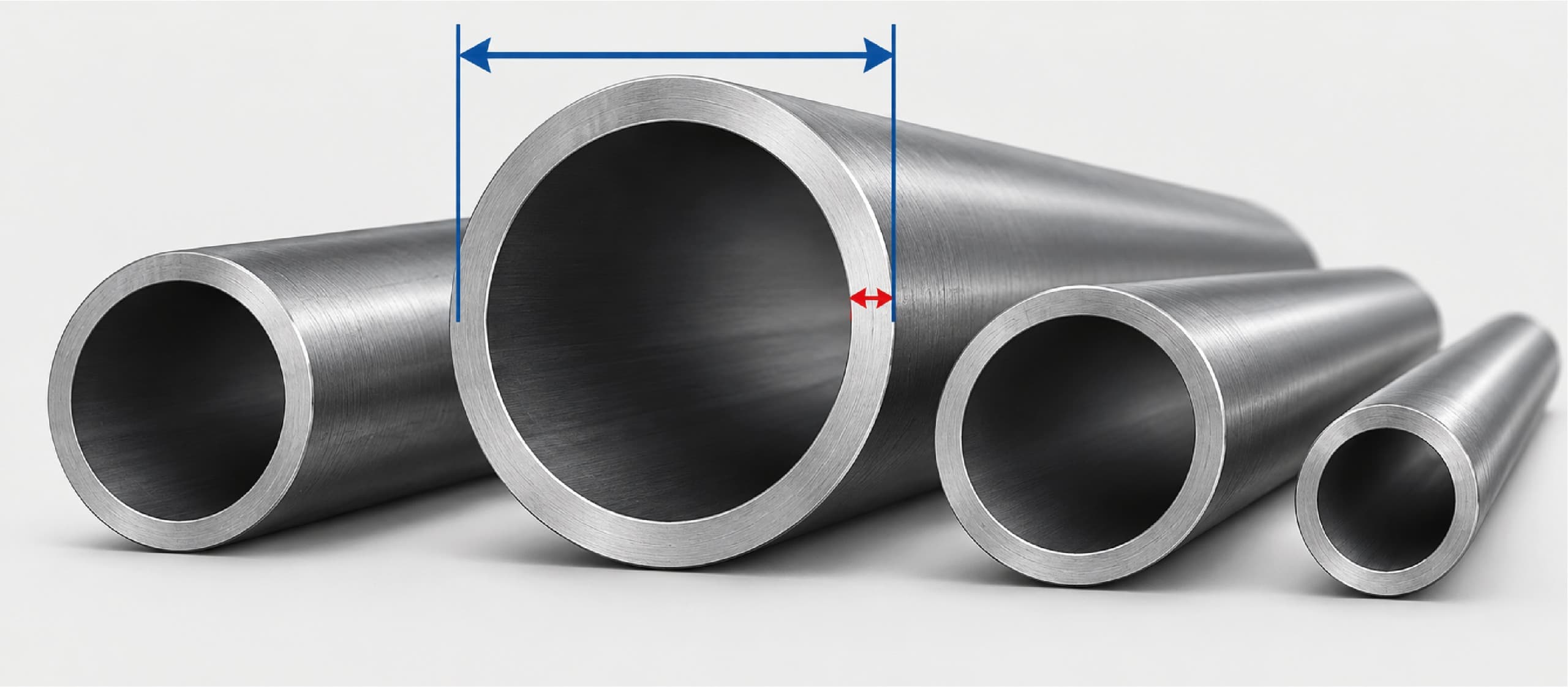
There are two actual, physical diameters on every steel pipe:
- Outside diameter (OD): the steel pipe outside diameter is fixed for a given nominal size, no matter how thick the pipe wall is. This is the number fabricators use most often when cutting, welding, or fitting flanges.
- Inside diameter (ID): the steel pipe inside diameter, also called the pipe internal diameter, changes depending on the wall thickness. A thicker wall eats into the bore, so the ID shrinks even though the OD stays constant.
So for any given nominal pipe diameter, the outside diameter is locked, but the pipe internal diameter and pipe external diameter (functionally the same as OD) move depending on the wall thickness chosen. This is exactly why two pipes with the same nominal pipe size but different schedules or thickness classes can carry very different amounts of fluid, or bear very different structural loads.
If you're specifying pipe for a project, always confirm the actual pipe diameter, not just the nominal figure. A steel pipe size chart from a reputable manufacturer will list both the nominal designation and the true OD side by side, which removes any guesswork.
How Pipe Wall Thickness Fits Into the Picture
Wall thickness is the second half of the equation, and it's just as important as nominal diameter, if not more so, when it comes to strength and pressure rating.
Pipe wall thickness is the distance between the outside surface and the inside surface of the pipe, measured straight through the steel. For a fixed nominal pipe diameter, steel pipe thickness can vary quite a bit depending on the intended use. A pipe carrying high pressure fluid needs a thicker wall than one used purely as a structural railing, even if both share the same nominal size and outside diameter.
This relationship is captured through standards. In India, structural steel tubes commonly follow IS 1161 and IS 3601 for circular hollow sections, while square and rectangular sections follow IS 4923. These standards define, for every nominal bore or outside dimension, which thickness ranges are permitted, along with the resulting weight per metre and mechanical properties like yield strength and tensile strength.
Here's a quick look at how this plays out for circular hollow sections under IS 1161, where nominal bore (NB), actual OD, thickness, and weight are all listed together:
| Nominal Bore (NB) | Outside Diameter (OD) | Thickness Range | Weight Range |
|---|---|---|---|
| 15mm | 21.3mm | 2.0mm to 3.2mm | 0.95 to 1.44 kg/m |
| 25mm | 33.7mm | 2.6mm to 4.0mm | 1.98 to 2.93 kg/m |
| 50mm | 60.3mm | 2.9mm to 4.5mm | 4.08 to 6.19 kg/m |
| 80mm | 88.9mm | 3.2mm to 4.8mm | 6.72 to 9.90 kg/m |
Notice how the outside diameter stays fixed for each nominal bore, while the wall thickness, and therefore the weight, changes across a range. That's the practical relationship between steel pipe nominal diameter and thickness in a nutshell: the nominal size sets the reference class, and the thickness determines how strong and heavy that particular pipe actually is.
Reading a Steel Pipe Dimensions Chart
Once you understand the terms, a steel pipe dimensions chart stops looking intimidating and starts being genuinely useful. Most steel pipe size charts, including the ones used for structural hollow sections, are laid out with these columns:
- Nominal size or bore (the labelled size, e.g. NB 40)
- Outside diameter (the fixed, actual OD in mm)
- Thickness (the available wall thickness options)
- Weight per metre (kg/m, which changes with thickness)
- Mechanical properties (yield strength, tensile strength, elongation, moment of inertia, and so on, for structural applications)
When you're comparing a pipe diameter chart across different standards, always check which standard it references. IS 1161 and IS 3601 charts for circular sections and IS 4923 for square and rectangular hollow sections won't always line up exactly with ASME or DIN charts, since standard pipe dimensions differ slightly by region and specification.
A good habit is to cross check the nominal diameter of steel pipe against the actual OD column before finalising a purchase order. This single step avoids a huge share of site level mismatches, where the wrong wall thickness or an unexpected OD holds up a project.
Why This Matters for Structural and Fabrication Work
For structural applications, in particular, getting steel pipe diameter and thickness right isn't just a paperwork detail, it affects load bearing capacity, weld quality, and long term durability.
Structural hollow sections (square, rectangular, and circular) are manufactured to precise dimensional tolerances specifically because engineers rely on the moment of inertia, section modulus, and radius of gyration values tied to each combination of nominal steel tube diameter and thickness. Even a small deviation in actual OD or wall thickness can change how a section performs under load, which is why manufacturers test each batch with equipment like digital Universal Testing Machines and spectrometers, rather than relying on nominal labels alone.
This is also where sourcing from a manufacturer that controls the entire process, from raw billet to finished section, tends to pay off. When the same integrated plant handles chemistry control, rolling, and welding, the actual dimensions on the pipe match what the steel pipe size chart promises, batch after batch.
Common Mistakes to Avoid
A few practical tips worth keeping in mind:
- Don't assume nominal size equals actual size. Always check the OD column on the chart before ordering.
- Match thickness to load, not just diameter. Two pipes of the same nominal pipe diameter can have very different strength depending on wall thickness.
- Confirm the standard. IS, ASME, and DIN pipe dimension charts aren't interchangeable, even when nominal sizes look similar.
- Ask for the weight per metre. It's a quick, reliable way to confirm you're getting the thickness you actually ordered, since weight and thickness are directly linked.
A Note on Sourcing Quality Hollow Sections
If you're working on a project that calls for structural steel tubes, whether square, rectangular, or circular hollow sections, getting consistent, tested dimensions matters as much as getting the paperwork right. SRMB RealFabrica manufactures ISO certified structural hollow sections conforming to IS 1161, IS 3601, and IS 4923, built on an integrated plant that controls everything from raw billet to the finished, welded section. Every batch is tested on digital Universal Testing Machines and spectrometers, so the nominal diameter and thickness on the chart match what actually reaches your site. You can explore the full product range and specification charts on our website.