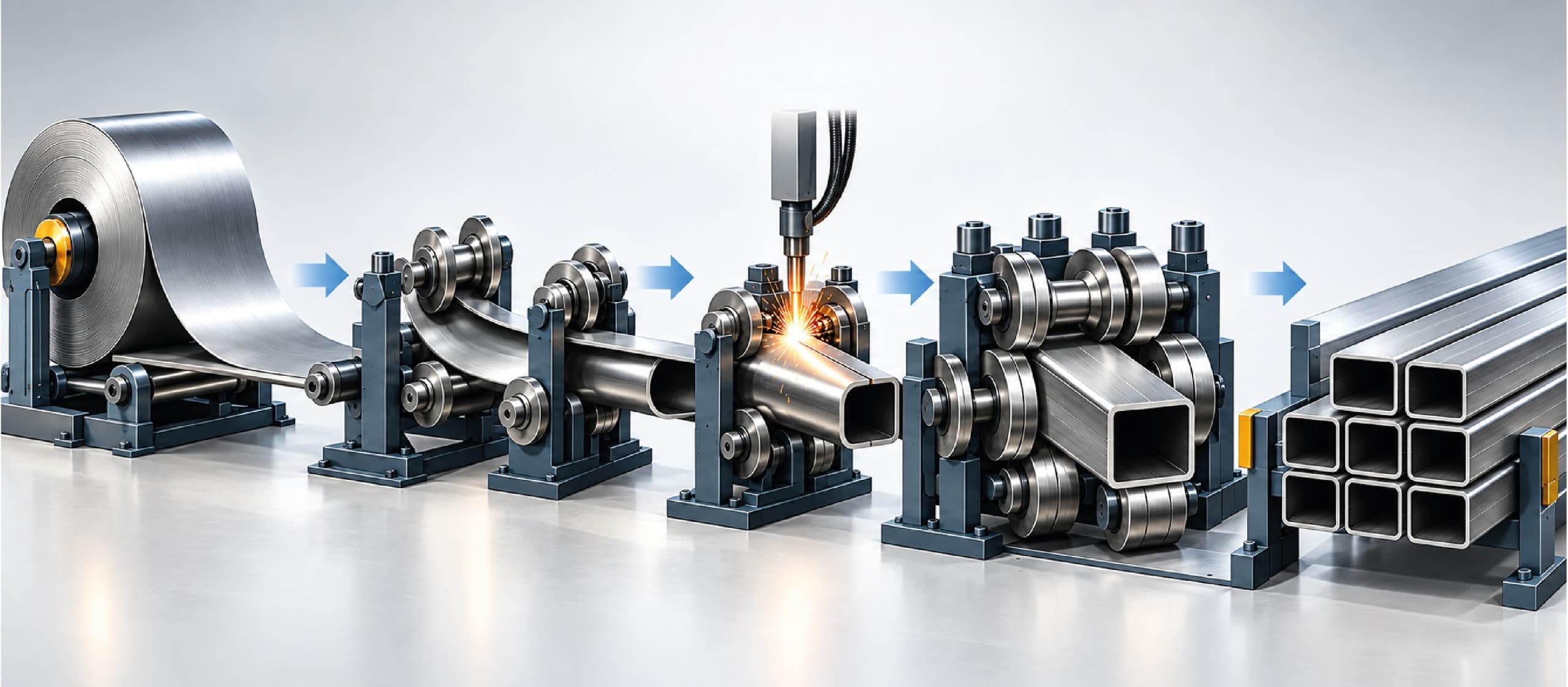
This guide walks through the RHS pipe manufacturing process from coil to bundle, following the way a cold formed ERW line actually runs. By the end, you will know what to look for when you order a rectangular hollow section for your next job.
What Is an RHS Pipe?
An RHS pipe is a hollow steel tube with a rectangular cross section. RHS stands for rectangular hollow section. Depending on who you ask, you will hear it called an RHS section, RHS hollow section, rectangular steel pipe, rectangular steel tube or simply a rectangular tube. In Indian trade, MS RHS pipe and mild steel RHS are the everyday names, while engineers write structural RHS or rectangular hollow steel section on drawings. Some buyers also say MS box section. It is all the same product family.
The sides are unequal, and that is on purpose. A steel RHS section resists bending far better along its longer axis than a square tube of similar weight, which is exactly what a beam or truss chord needs. In India, structural RHS pipe is made to IS 4923, the standard for square and rectangular hollow sections.
Where a Good RHS Pipe Starts: The Raw Material
Quality is decided before the steel touches a forming roll. Every RHS steel pipe we make is rolled from hot rolled (HR) coil with controlled chemistry as per IS 10748. Carbon, manganese, sulphur and phosphorus decide how well the strip forms, how cleanly it welds and how the tube behaves under load.
Behind that coil sits an integrated steel producer. SRMB Srijan, our parent company, runs a modern plant at Durgapur in West Bengal that makes billets from iron ore. Strict quality management at every stage is what delivers batch to batch consistency in each MS hollow section we ship.
The RHS Pipe Manufacturing Process, Step by Step
Our rectangular hollow sections are made on a cold formed ERW (CF ERW) line. ERW means electric resistance welded. Here is the sequence, as it runs on our line.
Step 1: Receiving and Uncoiling HR Coils
HR coils arrive at the line and are loaded on an unreeler. The strip is pulled through a strip leveller, which flattens the curve it picked up while wound. The strip width is matched to the perimeter of the section being made, so every size needs its own setup.
Step 2: Shearing, Joining and Accumulating
A shear squares off the strip end, and a MIG welder joins the tail of one coil to the head of the next. A coil accumulator holds spare strip so the mill keeps running during each join. Continuous feeding is what keeps an RHS pipe uniform from its first metre to its last.
Step 3: Stamping and Forming
The strip then passes a stamping station and enters the forming mill. Pairs of rolls bend it a little more at every stand until the flat strip becomes an open round tube with both edges facing each other. All of this happens at room temperature, which is why it is called cold forming. Bending in small stages keeps the wall thickness even and avoids edge cracks.
Step 4: High Frequency Induction Welding
This is the heart of the process. A high frequency induction welder heats the two edges to forging temperature, and squeeze rolls press them together. The steel fuses without any filler wire, so the weld carries the same chemistry as the parent metal. On a well run line, the seam on the finished tube is hard to spot.
Step 5: Cooling
The hot weld zone runs through a cooling trough, so the tube is at a stable temperature before it reaches the sizing rolls.
Step 6: Sizing and Turk's Head Shaping
The welded round tube passes through sizing rolls and then a Turk's head, a set of rolls that turns the circle into a rectangle. The rolls press until the faces are flat, the corners reach the specified radius and the outer dimensions land within tolerance. IS 4923 limits the corner radius to 3t maximum, where t is the wall thickness. One side effect: cold working hardens the corners, so they end up slightly stronger than the flat faces.
Step 7: Cutting, Straightening and End Facing
The tube is cut to length and finished on an end facing machine, which leaves a clean 90 degree plain end. Sections are supplied mill straightened, in standard lengths of 6 to 7 metres, or in exact lengths as per customer requirements. A twisted RHS pipe is one of the fastest ways to slow down a truss fabrication crew, so straightness matters.
Step 8: Testing and Quality Control
Chemical composition is checked on a spectrometer. Yield strength, tensile strength and elongation are checked on a digital universal testing machine (UTM). Dimensions, weight and welds are inspected too. All of this sits inside our PAWS technology: physical properties, accurate size and length, superior weld, and better surface quality and strength.
Step 9: Packing and Bundling
Finished RHS pipe lengths move onto a run-out conveyor for packing. Each bundle is strapped with a high tensile metal strip, and each section is embossed with the SRMB name, the ISI logo and the specification number. The finish is plain black.
Cold Formed vs Hot Finished Hollow Sections
You may see hot finished hollow sections quoted under standards such as EN 10210. They suit very heavy structures and larger sizes. Cold formed sections, made to IS 4923 in India or EN 10219 in Europe, cover the light to medium range of building frames, machine bases and architectural work. For most projects that use mild steel RHS between 40 x 20 mm and 96 x 48 mm, cold formed ERW is the practical and cost effective route.
Sizes, Grades and Tolerances You Should Know
This is what our rectangular hollow section range looks like under IS 4923:
| Parameter | Detail |
|---|---|
| Size range | 40 x 20 mm to 96 x 48 mm |
| Thickness | 1.0 mm to 4.5 mm |
| Grades | YST 210, YST 240 (higher grades also made) |
| Minimum yield strength | 210 MPa (YST 210), 240 MPa (YST 240) |
| Minimum tensile strength | 330 MPa (YST 210), 410 MPa (YST 240) |
| Minimum elongation, up to / above 25.4 mm | 12% / 20% (YST 210), 10% / 15% (YST 240) |
| Outside dimension tolerance | ±1%, minimum ±0.50 mm |
| Thickness tolerance | ±10% |
| Squareness | 90° ±2° |
| Corner radius | 3t maximum |
| Weight tolerance | +10% / -8% per length, ±7.5% per 10 tonne lot |
| Standard length | 6 to 7 metres |
Not every size comes in every thickness. Our 40 x 20 and 50 x 25 sections run from 1.0 to 3.6 mm, 80 x 40 runs from 2.5 to 4.5 mm and 96 x 48 runs from 3.2 to 4.5 mm. For reference, an MS rectangular hollow section weighs 2.15 kg/m at 50 x 25 x 2.0 mm, 4.25 kg/m at 60 x 40 x 3.0 mm, 5.50 kg/m at 80 x 40 x 3.2 mm and 8.22 kg/m at 96 x 48 x 4.0 mm.
How to Check an RHS Pipe Before You Buy
You do not need a lab to catch obvious problems. A few checks on site help:
- Look for the SRMB embossing, ISI logo and specification number on each section.
- Check the corners. The radius should look uniform, with no cracks or wrinkles.
- Run your eye down the weld seam. It should be straight and smooth, with no pits or undercut.
- Measure wall thickness at a few points with a micrometer or vernier caliper. Underweight tube is a common shortcut.
- Sight along the length for bow and twist.
If a bundle falls well outside the weight tolerance above, ask why.
Common Applications of RHS Pipe
Light for its strength and easy to weld with available MS electrodes, with no preheating needed, RHS pipe shows up almost everywhere:
- Architectural: glass curtain wall frames, partition frames, space frames, guard rails and staircases
- Industrial: sheds, storage racks, pipe racks, columns, trusses and roof support systems
- General engineering: greenhouses, exhibition stalls, furniture and solar power plant structures
- Infrastructure: bus stands, railway platforms, foot over bridges, stadiums and airport terminals
Source Your RHS Pipe from SRMB RealFabrica
SRMB RealFabrica manufactures IS 4923 rectangular hollow sections from 40 x 20 mm to 96 x 48 mm in YST 210 and YST 240 grades. Our parent company, SRMB Srijan Private Limited, has been making steel since 1951. It holds ISO 9001:2015, ISO 14001:2015 and ISO 45001:2018 certification and is classified as a Primary Steel Producer by the Joint Plant Committee under the Ministry of Steel.
Have a size, thickness or grade in mind?
Call our toll free line on 1800 890 2868, message us on WhatsApp at +91 9147245943, or send an enquiry through our rectangular hollow section page. Tell us about your project and our technical team will help you pick the right section and share a quote.